Friday, June 7, 2013

The Transylvania Twist: on Anton LaVey's Grandmother

In the 1968 first edition of The Satanic Bible LaVey speaks of his "Georgian, Roumanian, and Alsatian grandparents, including a gypsy grandma who passed on to him the legends of vampires and witches in her native Transylvania." In 1991's Secret Life of a Satanist he mentions "his maternal grandmother, Luba Kolton (born Lupescu-Primakov, from a Gypsy father and a Jewish mother), who regaled Tony with the mysteries of her Transylvanian homeland."

Yet many of LaVey's stories about his "Transylvanian grandmother" and "Roumanian heritage" appear inconsistent with known facts. US census records consistently show Luba Coulton's June 1868 birthplace as Russia. Her first child Fanny was born in the Russian Empire in December 1889.  In 1868 - and 1889 - Transylvania was part of the Kingdom of Hungary, not Romania. LaVey's bear-taming "great-uncle Laszlo," Luba's brother, had a Hungarian name: his chosen monicker, "Anton Szandor," is far more Budapest than Bucharest. He consistently identified with romanticized "Gyspy" stereotypes but showed no insider knowledge of Rom culture.

We could dismiss this all as harmless exaggeration.  But Luba Coulton had an enormous influence on her seven year-old grandson.  Throughout LaVey's career we see what the Portuguese call saudade, a longing for an unattainable, romanticized past.  In an American culture which valued conformity and progress, Grandma Coulton was his first tangible link to a strange and wonderful never-was.  He took her tales and added his own research -- research that included a good bit of fiction and dubious scholarship -- to tie himself to that magic and root himself in that history. And yes, he embellished and edited for dramatic effect.

The available evidence suggests Luba Coulton was born in the Russian Empire, not Transylvania or any other part of Romania.  An equal body of evidence (albeit with variant spellings like "Primakoff," "Premacov," or "Promerkoff") suggests her maiden name was indeed Primakov (Примаков). So there appear to be at least some reality amidst the legends. Finding it, alas, will be a challenging task. Perhaps all we can do is to compare these tales to history and the few available data points, then create our own stories with their own truths and inaccuracies.

And your mother too... 
Ukraine was traditionally home of the Zaporozhian Cossacks, a motley crew of escaped Rusyn (Ukrainian) serfs combined with mercenaries of various creeds and ethnicities.  The Zaporozhian Host provided many of the images and regalia that the modern world associates with Cossacks: they were also responsible for the infamous "Letter of the Zaparozhian Cossacks to the Sultan." And while Jews, Roman Catholics and Muslims were prohibited from their ranks, Roma who professed the Orthodox faith were welcome. Listed among the Zaporozhian Army's registries are names like Vasko Tsigan and Stepan Tsiganchuk (from the Russian/Ukrainian "Tsigan," or Gypsy).  There most practiced their ancestral tradition of metal work as smiths and armorers: others found work as horse traders or entertainers.

After the Zaparozhian Cossacks were disbanded in 1775, many Rom stayed in the area. Some kept up a nomadic or semi-nomadic style while others settled into the local villages. While some Roma kept to themselves, others became fully integrated members of their community. Indeed, today many Ukrainian Roma are unfamiliar with the Romany language and speak Ukrainian as their mother tongue. A young Jewish girl working in the marketplace might well be swept off her feet by a handsome young horse trader or blacksmith. 19th century Russians were enamored with Tsigani song and dance, praising them for their nomadic freedom and swarthy beauty.

If Luba Coulton's father abandoned her mother, it would be an enormous disgrace to her family. If he stayed around it would be even worse. As Bernard Wasserman describes it in On the Eve: The Jews of Europe Before the Second World War (p. 158).
An unmarried Jewish mother who could not persuade the Jewish father of her child to marry her before the birth could hardly remain in the shtetl and would be compelled to leave for the sheltering anonymity of a city or for America. Before departure, she might hand over the illegitimate child to nearby peasants (who might see the gift as an extra pair of laboring hands) or place the infant in an orphanage, if one were available. Under a false name, perhaps claiming to be an aunt, she might send money periodically to cover expenses for the child's upkeep.
If, however, the father were not Jewish and she married him (illegitimate children being the most common catalyst of such, still relatively infrequent, outmarriages in the shtetl) she would disgrace her family twice over: exogamy, after all, was hardly less of a disgrace then illegitimacy. 
Luba Coulton's mother was faced with a dilemma.  There were no civil marriages in the Russian Empire and marriages between Christians and non-Christians were illegal.  Marrying her Gypsy lover would mean losing her family and frie. Keeping the child as a single mother would mean an outcast's life for her and her baby, a life of clucking tongues and sneers and condemnation for a child whose only crime was being born.

Maybe Luba's father abandoned her pregnant mother.  Perhaps they relocated and set up housekeeping without a wedding. (The pious might sniff, but cohabitation was not uncommon among peasants unable to afford religious ceremonies and marriage licenses). Or perhaps they decided to make their wedding legal and their child legitimate: they decided the opportunities they would gain outweighed the community they had already lost.

The answer to that question will likely remain an eternal mystery. But two unusual data points give me pause. On the 1922 marriage license between Leslie Lowell Vaughn and Carolyn Coulton (formerly Katie Coulton), Carolyn spells her mother's maiden name as "Josephine Premacov."  And in the 1946/7 San Francisco City Directory Luba Coulton gives her middle initial as "J." I wonder if "Josephine" isn't the name which appears on her baptismal certificate.

If so, she, like her grandson, decided a change was in order.  57 years before Anton LaVey began his coming of age stint with the circus, the Coultons left Russia with their baby daughter and headed for one of the earliest Jewish settlements in what was then Ottoman Palestine.  And from the time they left Palestine a year later and headed for America she never again used "Josephine." Instead she went by the name her mother had always called her, the odd name that census takers and canvassers frequently rendered as Libbie or Liba, the Ukrainian Yiddish Люба (Lyuba), "Beloved."


Tuesday, April 23, 2013

A piece of gay history: Dr. Leo Louis Martello interviews Lige Clarke

In the course of my research for Project LaVey, I stumbled across an online copy of Dr. Leo Louis Martello's Weird Ways of Witchcraft.  Martello spoke favorably of Anton LaVey in his Black Magic, Satanism and Voodoo, and in 1994 private conversations with yrs. truly.  Martello never claimed to be a Satanist, although he was certainly embittered and cynical enough for the job when I met him.  (This happens to most starry-eyed romantics who survive long enough... and from his earliest days as a gay rights and pagan activist, Leo was certainly that).

Leo Martello wrote about Anton LaVey (and Herbert Sloane of the Ophitic Cultus Satanhas, whom I hope to talk about soon) and distinguished Witchcraft from Satanism while recognizing Satanism as a valid and meaningful spiritual path.  He also reminds us of one reason why there were a disproportionate number of gay men in the Church of Satan. From the beginning the Church of Satan has welcomed gay and lesbian members. Martello was one of the first "out" gay Witches: during the early days of American and British Witchcraft, most covens were all about "polarity" and shunned homosexuals as deviants who had no place in a fertility religion.  (American Pagans are almost universally queer-tolerant today, you protest? You can thank Leo Martello for that).  

Lige Clarke on cover of Gay #1
from Gay & Lesbian Review
Intrigued by his interview with a Kentucky folk witch named "Elijah Hadynn" I did a bit of Googling and discovered that Elijah Hadynn Clarke was better known as Lige Clarke, one of the editors of Gay, America's first weekly gay and lesbian newspaper.  (And a paper which featured Dr. Martello's column, "The Gay Witch").  So far as I can tell from some cursory searching, this interview has never been recognized as part of Lige Clarke's considerable and impressive body of work.  It is an important piece of gay and Pagan history, a meeting of two of the major figures of pre-Stonewall gay America.

* * * * *

I was warmly greeted by Elijah Hadynn, at his apartment on East 10th Street, in New York's East Village, when I visited him on the rainy night of April 18, 1969. The interview was arranged by John R. Nichols, editor of STRANGE / UNKNOWN MAGAZINE, and a writer on witchcraft himself. He had previously interviewed and written about Mr. Hadynn. I was ushered into a living room which had cushions and pillows arranged alongside the four walls, on the floor, "Moroccan style, like my villa in Tangier" I told him. Some of his own paintings hung on the walls. "I don't believe in lots of furniture" he said. We sat on the floor cushions. I told him "I had planned to bring you a broom." Laughingly he
replied "I could have used one."

Elijah Hadynn is a quiet, introspective young man, who looks more like a college student than a warlock (male witch). A glance at his handwriting told me that he was organized, systematic, ruled by his head rather than his heart, creative and constructive, and had the capacity to remain impersonal and detached from most situations; a far cry from the emotional hysteria characteristic of Middle Age witches. Backhand, precise, with clear well-executed letter formations, Mr. Hadynn was in full possession of his faculties, knew what he was and what he was doing at all times; the type of person who prefers to observe rather than participate. 

"I usually prefer to be alone" he said. "Parties as a rule bore me." This was confirmed by his handwriting which revealed that he would be more interested in ideas rather than just people per se, unless they were intellectually stimulating. Far from being an impulsive, impressionable, easily swayed person his handwriting indicated self-possession, control and discipline .... he would be master of his witchcraft rather than having it master him ... he would use it positively rather than being used by it negatively ... and unlike so many who become involved with the occult because of emotional impulses and drives, his mind would always be the controlling and decisive factor in any undertaking.

LLM: How did you first become aware that you were a witch?

EH: I always knew that I was different. I can remember the moment that I was born. It was on Cave Branch, in a little wooden house. I can vividly remember my first breath of air. I used to sleep with my hands outstretched with my thumb in between my two fingers. Years later I read that that was supposedly a sign of the witch. I often went on astral journeys. I'm ambidextrous, though I lean towards lefthandedness. I've had thirty six moles removed from my body ... another sign of the witch.  My mother was born the day before Christmas. My great grandfather was a Cherokee medicine man. There were two gypsies present at my birth, and one of them had said earlier 'A great man will be born in that house.'"

Elijah Hadynn was born in the hills of south-eastern Kentucky. Here is a fragment of a poem written about his birth:

In old Kentucky's snow white hills, 
Where tales of superstition grow, 
A warlock was born this day, 
Whose destiny the gypsies know.
His hair was white, it matched the snow 
That fell from cold and darkening skies. 
And as he grew, the magic gleam 
Flashed deep within his soulful eyes.

LLM: Do you belong to a coven in New York? 

EH: No. I'm basically a loner. If I do join one I intend to make absolutely sure that it's genuine.

LM: How many-other witches do you personally know here?

EH: I personally know only two others. One is a burlesque queen. The other a male witch. Of course I know of many many others.

LLM: What do you consider the best book on Witchcraft for the budding witch?

EH: One of the best is the Encyclopedia of Witchcraft and Demonology by Rossell Hope Robbins. It's full of facts and fascinating pictures of witches, especially during the time of the Dark Ages.

LLM: Do you know Sybil Leek?

EH: Yes. When we first met she was intrigued by my name, repeating it several times, saying "How lovely are the old names." She's a marvelous woman with a great sense of humor.

LLM: Do you believe in Reincarnation?

EH: Yes I do. I know that I have lived in the past and will exist again in another form in the future. This is what the Old Religion teaches. It's not something that I simply believe but something that I have always known. Sybil Leek and I both accept reincarnation as well as Astrology. Sybil Leek's 
grandmother used to bake cookies that had the signs of the zodiac on them.

LLM: Psychiatrists claim that the only reason why witchcraft works is because one believes in it. No belief ... no power. What's your viewpoint on this?

EH: The same could be said for psychiatry. Patients have spent fortunes going from one psychiatrist to another because they weren't being helped. It's what psychoanalysis calls "negative transference." It simply means that the patient isn't getting better, and the psychiatrist can't reach him. "Positive transference" simply means that the patient "believes' in him. So he's helped. Regardless of the techniques used it all boils down to the same thing: Faith and trust. Furthermore, psychiatry it-self isn't an exact science and when you stop to consider the many opposing schools of thought ... Freud, Jung, Adler, so many others ... the kettle can't call the pot black!

LLM: One psychologist has said, "Witches, sorcerers and the like are still trying to magically wish away the terrors of their own childhood. Instead of being afraid of bogeymen at night they resolve this by becoming bogeymen themselves." Is this true? (We both broke-up laughing at this question!)

EH: No, it's not true in the cases I know. That doesn't mean that it doesn't apply in all cases. But the question here is why do people become ministers, rabbis, priests, psychiatrists and psychologists? Aren't the former trying to align themselves on the side of God as appeasement for their own unresolved fears? And aren't the latter doing the same thing without religion? And their answer would be, "No, not true in all cases, but ..." In any event that's what they say but how do we know?

LLM: What do you think of organized religion?

EH: I don't believe in organized religion. They have caused mankind great unhappiness, burdened people with guilt, created conflicts, so that most people can't live a full life on earth, can't really enjoy themselves without looking over their shoulder in fear that the "Hand of God" would punish them. The most unhappy people I know are very religious. What has witchcraft ever done in this world to compare with the bloodshed and tyranny caused by organized religion? When I think of this, if I wasn't a witch, then I'd have to become one.

LLM: Anton LaVey, high priest of the Satanist Church in San Francisco, has called white witches neopagan Christians, skulking around under a burden of guilt, afraid to be called evil, tea shoppe witches,  plump little women sitting around threatening to turn each other into toads." Any comment?

EH: I don't accept that. I'm not interested in black magic or black witches, so-called. I call what I do white witchcraft because it's for good, to help others and myself. White witches have minds of their own and the Christian Church plays no part in our basic views. Just look into history and you'll find that white witches have always overpowered the black practitioners. White witchcraft has existed long before there ever was a Christian religion, as any historian can prove.

LLM: Isn't the devil or Satan as we have come to know him the creation of Christian theologians rather than that of the pre-Biblical Old Religion?

EH: Yes, definitely. The devil or the host of other names given to him, has never been given so much attention as it has in the Catholic Church. No other God of Darkness has been so deified in other religions as it has been in Christianity. One could ask: Is the Satan one worships a Christian black God or that of the Old Religion?

LLM: Could you elucidate more on White Magic?

EH: Yes, let me quote you from my article in the May-June 1969 PERSONAL HOROSCOPE 
MAGAZINE, entitled "What Is White Magie?"
Lige Clarke.
photo by Eric Stephen Jacobs
A true witch knows that it is wise to take no notice of opposites or extremes. To divide the world into black and white, good and bad, beautiful and ugly, is to fail to look at it with real scrutiny. Magic is a power, in much the same way that nuclear energy or electricity is a power. Like these forces magic exists throughout the whole of creation, waiting for practitioners to cast its spells in unusual and unexpected ways. But it lies dormant and has no real character of its own until used. It is the character of the person who employs, magic that determines what kind of label it may claim. In the hands of the unscrupulous and malevolent person, magic is, according to the way most people think, black. But if a knowledgeable individual who is generally kind and thoughtful of others, uses magic, it becomes a wonderful tool, a potent and amazingly beneficial tool for mankind. Such a person is a miracle worker who heals, cures, and fixes things that are broken. Because he sees more clearly than most, he is able to guide ordinary people into paths of good fortune. In its pure state, magic is neither good nor bad. It is simply magic.

LLM: Do you engage in any witchcraft rituals, and if so what objects do you use?

EH: No, I don't engage in the usual rituals, with the exception of candles and of course herbs. Mine is more of a mental ritual rather than a physical one.

LLM: How do you earn your living?

EH: I'm both a practitioner and a teacher of Yoga. I have private students and classes. Yoga has helped me greatly as I've always had a health problem. The self-control over the body obtained by Hatha Yoga is now scientifically accepted, yet it is a natural method, one long known to witches, yogis, fakirs and mystics before science discovered that it works. I also write articles for various magazines such as STRANGE I UNKNOWN and YOUR PERSONAL HOROSCOPE.

Mr. Hadynn then gave me copies of these magazines which had articles both by and about him. I noted that on the inside back cover of the first there was an advertisement for books including two of mine, IT'S IN THE CARDS and IT'S IN THE STARS. 

In an article "The White Witches of England" by John R. Nichols in the Jan.-Feb. issue of Personal Horoscope the author tells about a personal experience he had with Elijah Hadynn:

Of course, witches do practice incantations, and rely on the powers of magic to accomplish their ends. On one occasion, to show me how such tricks work, Elijah put a broomstick in the corner of a room to get rid of an unwanted guest. 

He explained that the guest would stay no more than a half-hour after the broomstick had been placed. For a few minutes I doubted the efficacy of this procedure. The guest seemed intrigued by the sound of his own voice, and he talked on and on at an increasingly rapid rate. Suddenly, after only fifteen minutes had passed, he stood up and said, 'I must be going.' Without further ado, he wished us farewell and was gone.

Thursday, April 4, 2013

About William Daixel or, a prelude to Lili St. Cyr, Marilyn Monroe, Anton LaVey and an LA Porn Palace

From Secret Life of A Satanist:
Every couple of weeks the theme changed at the Mayan Burlesque Theater. This performance centered on Paris, so the organist played a bootlegged, handwritten arrangement of “Hymn a L’Amour,” just composed by Edith Piaf’s accompanist, not yet released in this country. The dancer? – Marilyn Monroe...

LaVey and Marilyn shared a cultural hunger as well. Paul Valentine (aka “Val Valentino”) was an exceptionally fine dancer and choreographer at the Mayan. He was at that time married to legendary stripper Lili St. Cyr, whose act Anton had played for at Zucca’s. “Paul Valentine thought I was a weird kid. Marilyn and I used to go up to the balcony together when they were running arty filler movies like Amok and Omoo, Omoo, the Shark God. One time I heard Valentine say to the straight man, ‘I think they actually watch the movies up there.’ We did. We were hungry. We wanted to learn – listen to the Bizet score or examine the sets.”
Valya Valentinoff
When 14 year-old William Daixel joined the Ballets Russe in 1933, director Léonide Massine renamed him "Vladimir Valentinoff." In September 1937 "Valia Valentinoff" danced in the premiere of Arthur Schwartz's Virginia. As "Valya Valentinoff" he played New York's Riobamba Room in 1943 alongside a young crooner named Dean Martin.  But when he headed West to try his luck in Hollywood Daixel/Valentinoff settled upon a final name: Paul Valentine. He appeared as Paul Valentine in the 1947 noir classic Out of the Past.  He is listed as Paul Valentine on the 2006 Social Security Death Index. And in August 1946, when burlesque star Lili St. Cyr tied the knot with her trainer and choreographer, he signed the Tijuana marriage license as Paul Valentine.

The couple were together in Los Angeles in late November 1947, when St. Cyr began an engagement at the Follies.  In March 1948 St. Cyr and Valentine played together at Florentine Gardens in Hollywood. By the end of June St. Cyr was back at Montreal's Gayety Theatre (where she had been a headliner since 1944), and headed north yet again in September 1948. Around the same time Paul Valentine was working in Los Angeles at the Mayan with burlesque producer (and later 3-D pioneer) Sidney Pink. According to Uno (Charles Feldheim), Variety's burlesque columnist, their show was called "French Postcards revue."

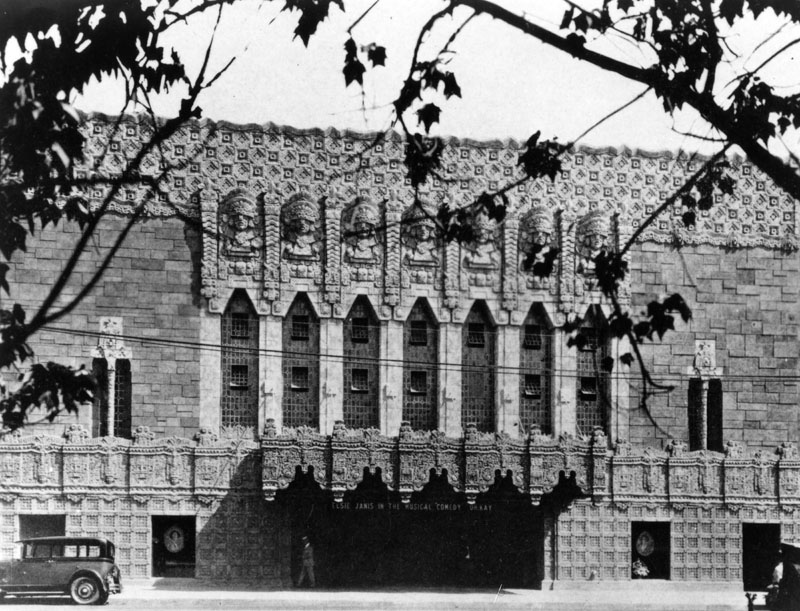
Mayan Theater, 1927
Given all this, we must wonder why Paul Valentine told Lawrence Wright in 1990 that he operated the Mayan as "legitimate theater - it was never a burlesque, never a bump and grind."  Perhaps he was still bitter about his failed marriage to St. Cyr. In 1949 he filed for divorce and was famously quoted as saying "Everybody in the country could see more of her than I did."  (His 1952 marriage to heiress Flaveen Sultana Ali Khan appears to have been more successful: they had a son in 1956 and I can find no record of their divorce).   Or perhaps we should consider his statement in the proper context.

Under Valentine's tutelage St. Cyr incorporated elements of classical ballet and modern dance into her routines. Instead of playing to the audience she presented erotic mini-dramas from behind the fourth wall. Recreating Cleopatra and Salome, playing a suicidal spurned lover, re-enacting The Portrait of Dorian Grey  -- these and other dances owed more to Martha Graham than Busty Morgan.  St. Cyr and Valentine dreamed of making burlesque an art form, of winning the kind of respect Josephine Baker received in Paris.  Her act, and his choreography, went far beyond the standard "bumping and grinding" of an average girlie show.

It is also possible that Valentine worked as a dancer or choreographer at the Mayan in earlier, less bawdy productions. Burton H. Wolfe discovered a March 8, 1948 Los Angeles Times review entitled "Mayan Offers Burlesque" which noted that "the producers have toned down luridness somewhat since the last show." The Mayan does not appear in Uno's Billboard column until April 10, 1948, when he talks about an ongoing show.  All Billboard mentions of the Mayan before that date describe big bands, operettas, musicals and theatrical productions.  It appears that burlesque was a final failed effort to bring in crowds and one which only lasted a few months. At the end of December the Mayan was sold to Frank Fouce, who in 1949 turned it into a Spanish language theater and cinema.

But Mr. Fouce was not the Mayan's last owner.  By 1990, when Valentine was interviewed, the Mayan  had been an adult theater for twenty years.  The "daring" and "torrid!!" naughtiness of postwar burlesque had long since been replaced by live sex shows and lap dances: the neo-Burlesque movement was barely a twinkle on somebody's pasties. Valentine was over 70, still healthy and vigorous but definitely at an age when one considers his legacy.  In most ways his was a typical Los Angeles life.  He was a dreamer who came west, better looking than many and more talented than most, a guy who never got to be Hamlet but who played his share of attendant lords.  Perhaps we can forgive him for downplaying the two months he spent directing a strip show at a notorious porn palace.

Which brings us back to Anton LaVey.  Not long before Valentine was interviewed, LaVey told Blanche Barton that he had, in October 1948, played the organ at the Mayan Theater for a Paris-themed burlesque show directed by Paul Valentine.  And, if Billboard is to be believed, there was indeed a "French Postcards Revue" directed by Paul Valentine playing the Mayan Theater at that time.  This says nothing about whether or not LaVey -- never mind Marilyn Monroe -- worked at that show. But it certainly does suggest a certain familiarity with the inner workings of the Los Angeles burlesque scene. Because I very strongly doubt that most of the men who just attended that show remembered who the choreographer was fifteen minutes after they left, never mind forty years later. 

Tuesday, March 12, 2013

Polk-Ing Around San Francisco: Anton LaVey in the City Directories

According to Blanche Barton's The Secret Life of a Satanist, after his September 4, 1951 marriage to Carole Lansing
Anton... combined his education in Criminology with his talents in photography in a job with the San Francisco Police Department as a police photographer. Once again, he was faced with the worst side of human nature on a daily basis. On call 24 hours a day, he would race across town to photograph a murder site, suicide, auto accident, explosion – anything that required an investigation because of the gravity of the situation.
This claim (like many others) has been disputed. Lawrence Wright found:
According to the San Francisco Police Department, no one named Howard or Anton LaVey or Levey ever worked for the force, nor does City College have a record of his enrollment. Frank Moser, a retired police officer who worked in the photo department during that time, says that LaVey was never in that department under any name.
Though I have not yet contacted the SFPD or San Francisco City College, I have examined some contemporary San Francisco city directories.  (The SFPL has kindly made a near-complete collection of directories from 1850 to 1982 available online).  Here are two listings for Anton S  LaVey: I've emphasized his stated career for each year.

While the 1952 directory is unavailable, I found this listing on page 719 of the 1953 directory.
LaVey
Anton S (Carole) photographer h729 47th Ave  
And though there's no listing for Anton S or Carole LaVey in 1954,  page 750 of the 1955-6 city directory has:
LaVey
Anton S (Carole) legal photographer h729 47th Ave 
So why were there no SFPD employee records for an Anton LaVey, Tony Levey, Howard Levey, etc.? One possible answer can be found in The Black Pope, Burton Wolfe's second edition of 1974's Devil's Avenger.  In the account LaVey gave Wolfe, after his marriage to Carole and the birth of his daughter Karla in 1952
Anton survived financially through part-time jobs playing organ and piano, and by shooting photos of damage caused in traffic accidents, fires, and street brawls... 
As Anton traveled around San Francisco looking for opportunities to sell photographs to insurance companies and the police, he sometimes came upon the results of humanity at its worst: homicides, suicides, damage from arson-caused fires, wrecked vehicles with injured or dead drivers or passengers immersed in blood, bodies hauled out of the San Francisco Bay where they had been tossed after murders or where they had wound up in a submerged automobile, the bodies of women maimed or killed by jealous lovers, men stabbed or shot by their “best friends,” children whose bodies were splattered on the sidewalk or street after being blasted by hit-run drivers. What sickened Anton almost as much as the disgusting scenes were the usual hordes of gawkers sucking sadistic pleasure out of the tragedies: sometimes after they had the opportunity to help prevent the outcome, but did nothing.  
While many police departments did and still do use freelance photographers, I do not know if the San Francisco Police Department ever did.  Even if they worked with freelancers I could not tell you how many pictures, if any, the SFPD purchased from a young Anton LaVey. And the directory publishers stated that they "cannot and do not guarantee the correctness of all information furnished to them." But what I do know is this: from 1953 to 1956 Anton LaVey listed himself as a "photographer" and then a "legal photographer" in the San Francisco City Directory. And I wonder why, more than fifteen years before The Satanic Bible saw print, he would lie about such a thing repeatedly.  Especially since there's abundant evidence that he was telling the truth when he later listed himself as an "organist" and then "organist at the Lost Week-End."

Were he not deceased, I'd talk to retired SFPD Inspector Jack Webb.  Inspector Webb told Lawrence Wright he "knew LaVey in the late forties or early fifties." It is a pity Wright didn't ask him about LaVey's early photography career or about his criminology courses. (If Webb's obituary was any indication, he would have been taking classes around the same time as LaVey). I wonder what that conversation might have revealed.

Monday, February 18, 2013

LaVey and Reich: More for Chas Clifton

In a response to my earlier post on Existentialism, Archetypes and Anton LaVey, Chas Clifton said:
I would say that Pagans of the 1960-1970s were all over the map,from the vaguely pantheistic Reformed Druids of North America to the new Witches, some of whom felt that their gods were two among many, while others clung to Dion Fortune's statement that "All the gods are one god, and all the goddesses are one goddess."  
And there were a few reconstructionists about too, though not a lot.
What you're describing is a range from polytheism to duotheism with some reconstructionism and pantheism thrown in. LaVey's practices were avowedly atheistic. He didn't see the gods and goddesses as symbols of a higher Being/s but as tools to be used for personal betterment and gratification. In that, for better or for worse, he was several decades ahead of the Pagan curve.  

Confusion about LaVey's atheism is understandable.  He talked about curses decades after he stopped doing Black Masses and suggested that many seemingly unconnected events were more than "coincidence."  LaVey certainly wasn't a hard atheist whose worldview was free of supernatural and mystical elements like the Brights.  But he repeatedly rejects the idea of Satan as a personal being and consistently shoows contempt for "wooly-headed mysticism" and "occultniks."

Many of these seeming contradictions can be resolved by studying an important but oft-neglected influence on Satanism.  In the first edition of The Satanic Bible we find a dedication to, among others, "Wilhelm Reich, who knew more than cabinet‐making." In 1990's Secret Life of a Satanist we find:
An interesting sidelight to LaVey’s humanoid creations is that many human replicas of his "people" have suddenly appeared, Pygmalion-like, some time after LaVey already constructed his creation. Instead of modeling the humanoid after a person, the person seems to have been modeled after the humanoid. Anton doesn’t try to explain these "conjurings" beyond referring to a method he uses in magical rituals which he terms "cosmic superimposition," a phrase borrowed from Wilhelm Reich.
According to The Wilhelm Reich Infant Trust, in Cosmic Superimposition (1951), Reich "steps out of our current framework of mechanistic-mystical thinking and comes to a radically different understanding of how man is rooted in nature. " Compare LaVey's efforts to remove Christian conditioning via the Black Mass to Reich's work on "character armor." Reich sought to bridge the mind/body duality, while LaVey commented in The Satanic Bible that man:
... no longer can view himself in two parts, the carnal and the spiritual, but sees them merge as one, and then to his abysmal horror, discovers that they are only the carnal—AND ALWAYS WERE! Then he either hates himself to death, day by day—or rejoices that he is what he is!
And of course the "dark force in nature" bears more than a passing resemblance to orgone.  This is especially important when considering LaVey's theology.  Whether you find Reich's ideas  to be genius, quackery or some combination thereof is unimportant. What matters is that orgone is impersonal. Orgone does not hold conversations or deliver cosmic mandates: it is more like light, magnetism or electricity than any kind of spiritual entity.

Reich would certainly have been trendy enough in the 50s and 60s: orgone accumulators were used by (among others) Norman Mailer, J.D. Salinger, Saul Bellow, Allen Ginsberg, Jack Kerouac and William S Burroughs. His work combined psychotherapy and bodywork to help patients achieve full emotional expression and rid themselves of sexual repression, or, in sixties-speak, "hang-ups."  LaVey thought liberation from self-loathing and socially induced guilt was a worthy cause: his rituals used occult imagery toward that end for psychodramatic effect.  (Note that he moved away from and ultimately dumped the ceremonial magic trappings altogether when too many people started taking them literally).

But LaVey was far less impressed with Reich as a prophet of sexual liberation and "free love." He rather enjoyed a little bit of shame, saying in 1969:
I would rather be “hung-up.” It’s a lot more fun. This is why the Satanist revels in what are considered to be sins. We Satanists consider “hang-ups” to be “hang-ONS”—the very foundations of what makes our personality, our likes and dislikes what they are. We like our fetishes and resent any attempt to remove them. 
Like the carnival, LaVey's rituals exist on the edge of the orderly world.  They are a Dionysian celebration of the flesh, a multi-sensory experience designed to touch the participant on deep levels. But when the carnival moves on and the ritual chamber closes, everyone goes home empowered, or hopefully at least entertained.  Where Reich and his devotees sought an aeon-changing sexual revolution, LaVey never dreamed we would fuck ourselves into utopia.  He understood the Church was Satan's best friend too: he knew everything was nicer with a little sin sprinkled on top.  And his innate distrust of utopian philosophies only became stronger as he grew increasingly bitter.

Monday, February 11, 2013

More LaVey: The Mystery of the Second Oboe

Throughout his career as Black Pope Anton LaVey swore that he had played second oboe for the San Francisco Ballet Orchestra.  Yet in 1991 Lawrence Wright found:
By the time he was fifteen, [LaVey] said, he was sufficiently accomplished to play second oboe with the San Francisco Ballet Orchestra.  (According to the San Francisco Performing Arts Library, there was no such orchestra in 1945. The ballet employed the local symphony for its performances, and none of the three oboists was named LaVey or Levey).
In the introduction to the first edition of The Satanic Bible (which appeared from 1969-1972) Burton H. Wolfe stated "At sixteen [LaVey] became second oboist in the San Francisco Ballet Symphony Orchestra." He repeated that in his 1974 book The Devil's Avenger (which he edited and re-released in 2008 as The Black Pope).  Only later did LaVey change that number to fifteen.

Is this proof he was lying? Or is it proof he was born on April 11, 1930.

I wonder what the local symphony's employment records might reveal for the first half of 1946.  I also wonder how many ballet companies were active in San Francisco at the time.  And given that LaVey was living in Mill Valley in 1945-1946, I'd like to see if contemporary local papers mention a young "Howard Levey" playing oboe in San Francisco.

The oboe's tone is frequently associated with Orientalism and the exotic, so it would appeal to a teen steeped in 1940s pulp fiction. And given his resume there's no reason to think he wouldn't be up to playing a double reed instrument.  By 1969 Anton LaVey had spent over a decade as a professional musician. Why make up a story about "playing second oboe at 15" when he could point to several years manning the Civic Auditorium's pipe organ or the Lost Weekend's Wurlitzer?  And why keep talking about that particular instrument and that particular position for decades?

This night, I believe, was a pivotal experience in LaVey's life.  It was so important that he went back and corrected a misunderstanding ("Yes, I said 1946 but I was fifteen, damn it, fifteen.").  For a suburban kid San Francisco was the big leagues.  It was that glorious first gig that sealed his fate, that moment when "musician" became a real career possibility.  And even when he put his oboe aside and took up the organ, he never forgot it.  So no, I don't think he made the second oboe story up or embellished it in any significant way. If anything, I'd bet it was honesty that got the Black Pope in trouble.

Can I prove that with documentation? No. (Anybody with access to 1940s Marin County newspapers might want to give it a shot).  But given how often LaVey repeated this story, and how tenuous the case against him is, I'm reasonably certain he was telling the unvarnished truth here.

The Satanic Bible's first edition also contained a very interesting dedication. But that's for another post.

Tuesday, February 5, 2013

More for Chas Clifton: Existentialism, Archetypes and Anton LaVey

On G+ Chas Clifton said in response to my previous post:
I would comment on your blog if you just had the name/URL option. Or if WordPress ID worked, the failure of which is not your fault.
I've allowed anonymous quoting, which should allow you to quote with name/url. Let me know if that works. 
 
I would definitely appreciate hearing your thoughts on this subject, especially on the 60s-70s Pagan and "white light/occultnik" religions. I am curious as to how many Pagans in the 1960s had a similar pantheistic-atheistic-archetypistic worldview. At present I think a fair number of Neopagans, maybe even a majority, would have no problem saying that "the God and the Goddess represent the forces of nature and are symbolic rather than actual anthropomorphized entities." But I'm not sure if that was the standard view in the 1960s or if most of the community believed they were contacting the actual Old Gods and Goddesses. Was LaVey ahead of the curve in 1966 with this worldview, or was he was following a contemporary trend? I honestly don't know.

(Although I suspect that if I show a LaVeyan influence on contemporary Neopagan thought Isaac Bonewits will spin in his grave so fast that he breaks the sound barrier ;) ).

One thing I'm finding is that LaVey was a lot smarter than people think. They forget that before he was Anton Szandor LaVey he was a kid named Howard who spent his days reading everything he could get his hands on and remained a lifelong voracious bibliophile. I definitely see a Reichean influence in LaVey's conception of a "dark force in nature," for example. (Considering LaVey dedicated the first edition of The Satanic Bible to Reich among others, I think that's a pretty safe assumption). A lot of times I think what his enemies call "plagiarism" is him using ideas and phrases which caught his attention and which he internalized. Keep in mind he was an autodidact with no college education: it's not surprising that his attributions sometimes didn't measure up to academic standards.

I'd like to bone up on contemporary Existentialist texts to see if there's any influence there. While I don't think Sartre or Camus would necessarily disagree with many of his thoughts on the human condition or his proposed solutions therefor, I would like to make sure first that LaVey actually had some interest in Existentialism.  It wouldn't be implausible: plenty of intellectuals in the 1950s were reading Sartre, or at least leaving his books lying around on their coffee table. But I'd like to get something more to solidify any linkage.  And I'd also note that for somebody who hated "occultniks" so much, he had at least a passing familiarity with most of the material available to a mid-20th century scholar of the occult. I've come to suspect the Doc hated occultniks so much not because they were interested in magic but because their magic was ineffective.